Internal design details
Parsing
The grammar for a valid katcp message can be recognised with a regular expression, and the parser uses a corresponding deterministic finite state machine (FSM). Each edge in the FSM has an associated action which indicates what to do with the matching character.
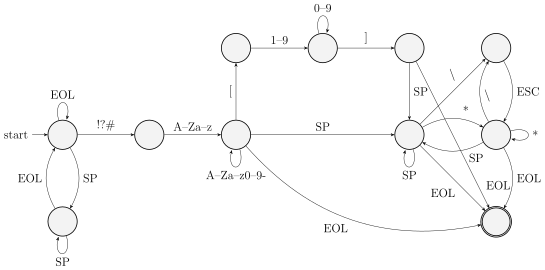
The following abbreviations are used
- ESC
Characters valid after a backslash:
@\\_0nret- SP
Space or tab
- EOL
Carriage return (
\r) or newline (\n)- *
Any byte except for NUL (
\0) or ESC (\x1B)
There are two additional states that are not shown: an error state, and an additional error state for immediately after encountering an EOL. Encountering any character that is not shown will transition to one of these states.
Acceleration
Using a state machine makes it quite straightforward to build up a message incrementally. Unfortunately, the initial implementation was quite slow, because character of the message are appended to the storage one byte at a time. An acceleration mechanism allows the input to be processed in chunks. After taking one transition in the state machine, we scan over following characters to find a maximal chunk that can be processed in one step. For additional transitions to be combined with an initial one, they must:
go to the same target state;
take the same action;
take an action that supports chunks;
not start a new argument; and
not go to a terminal state.
To speed up this test, each transition is accompanied by a 256-entry boolean table that indicates which characters correspond to transitions satisfying these conditions.
Given a complete message as input, this allows the following to be handled in a single chunk:
the message ID
the name
each argument.
Additionally, exceeding the maximum message length causes a transition to error state, but this is not represented by the state machine. So the code to scan for the chunk size has extra logic to stop the chunk if it would cross that boundary.
Build-time table generation
The state tables are generated programmatically, but it could be expensive to do so each time a Parser is instantiated. Instead, a Rust build script is used to generate the tables at build time, and format them as Rust source code. The generated code is included into file:src/tables.rs.
This introduces a complication in that the build script and the run-time parser
need to share the State and Action enums. That’s implemented by using a Cargo
workspace, with a separate crate in crates/fsm holding the actual
definitions of these types.